> ## Documentation Index
> Fetch the complete documentation index at: https://doc.entelligence.ai/llms.txt
> Use this file to discover all available pages before exploring further.
# AI coding tool connectors
> Connect and map Cursor, Claude Code, and Codex data for Agent Insights; understand platform, OpenTelemetry, CLI, and user-mapping paths.
The current app exposes Cursor, Claude, and Codex under AI Analytics. Copilot is marked Coming Soon.
## Cursor
**Settings → Team → Cursor** can expose an organization API key, automatic user mapping, analytics, and key update or removal. Verify suggested mappings before relying on member-level analytics.
## Claude Code
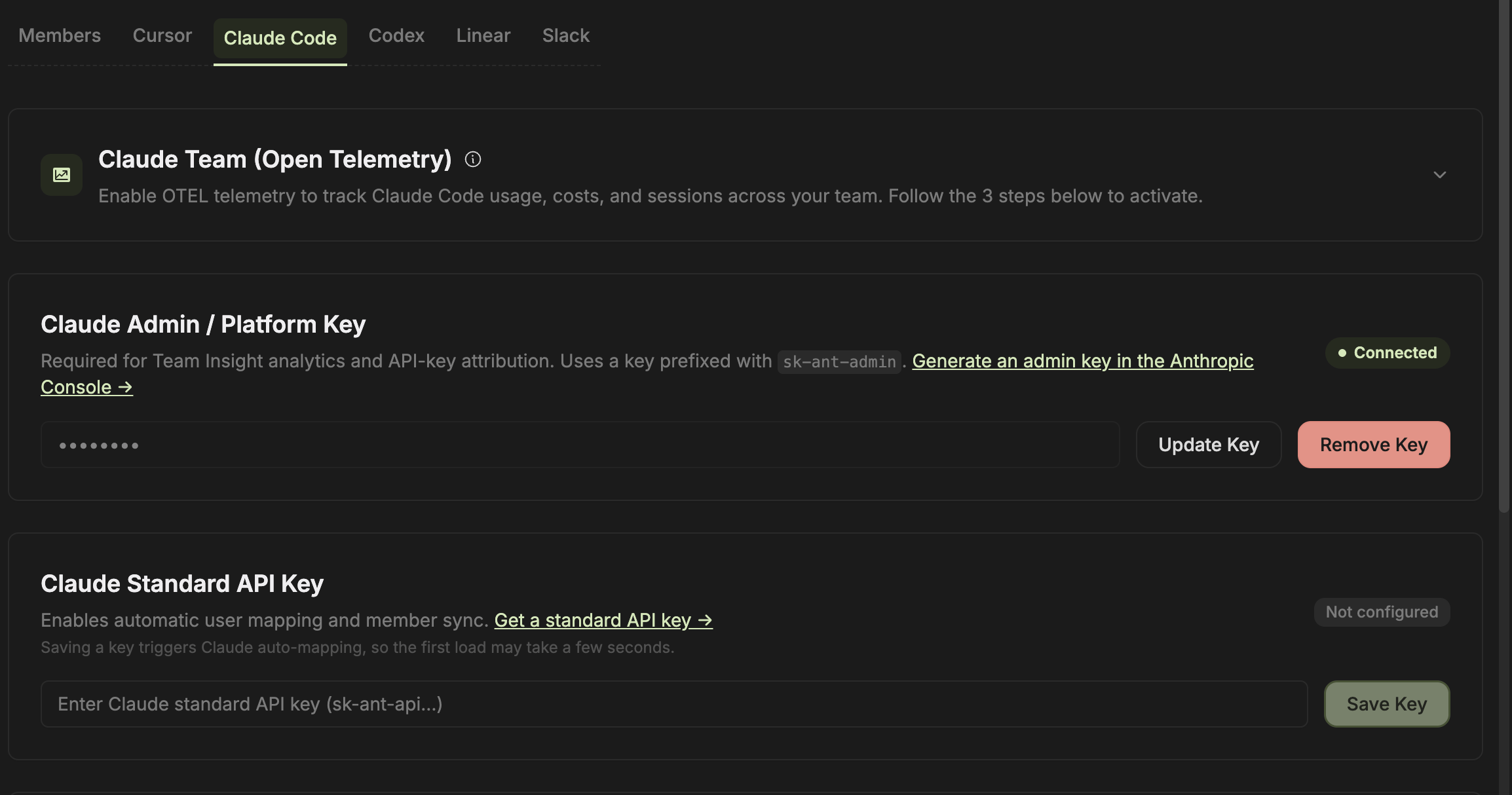
The Claude Code setup can expose:
* OpenTelemetry configuration
* Anthropic admin or platform key
* Standard API key
* User mapping
Choose centralized OpenTelemetry when the organization operates a trace pipeline, or use a supported local CLI path for a pilot. Check for duplicate ingestion if multiple paths are enabled.
 ## Codex
The Codex setup distinguishes OpenAI Platform organization usage from ChatGPT Enterprise Codex workspace analytics. Choose the source that matches how the organization buys and uses Codex, then verify user mapping.
## Local CLI collection
Authenticate first:
```bash theme={null}
entelligence auth login
entelligence auth status
```
Use the explicit local workflow to inspect each stage:
```bash theme={null}
entelligence insights setup
entelligence insights index --source local
entelligence insights analyze
entelligence insights sync --dry-run
entelligence insights sync
```
| Command | What it does |
| -------------------------------------------- | ----------------------------------------------------------- |
| `entelligence insights setup` | Prepares local Agent Insights collection |
| `entelligence insights index --source local` | Discovers and indexes supported local coding-agent sessions |
| `entelligence insights analyze` | Processes the indexed data into supported derived metrics |
| `entelligence insights sync --dry-run` | Previews the synchronization without uploading |
| `entelligence insights sync` | Sends the prepared Agent Insights data to the workspace |
The combined `entelligence insights --agent` workflow can gather supported sessions, prepare the Agent Insights data, synchronize it, and arm the daily workflow. Use `entelligence insights schedule --at 09:00` to manage the recurring time.
Exact source availability, arguments, and flags depend on the installed CLI version. Run `entelligence insights --help` and the relevant subcommand help before rollout.
Agent analytics can expose member-level behavior and spend. Publish an appropriate-use policy and verify uploaded fields before broad collection.
## Verify
* The expected source is included.
* Test activity maps to the right member.
* Tool and model names are plausible.
* Unresolved users remain unresolved instead of being guessed.
* Removing or rotating the credential behaves as expected.
## Next step
Follow the [Agent Insights rollout](/agent-insights/setup) or review the [CLI command checklist](/cli/reference).
## Codex
The Codex setup distinguishes OpenAI Platform organization usage from ChatGPT Enterprise Codex workspace analytics. Choose the source that matches how the organization buys and uses Codex, then verify user mapping.
## Local CLI collection
Authenticate first:
```bash theme={null}
entelligence auth login
entelligence auth status
```
Use the explicit local workflow to inspect each stage:
```bash theme={null}
entelligence insights setup
entelligence insights index --source local
entelligence insights analyze
entelligence insights sync --dry-run
entelligence insights sync
```
| Command | What it does |
| -------------------------------------------- | ----------------------------------------------------------- |
| `entelligence insights setup` | Prepares local Agent Insights collection |
| `entelligence insights index --source local` | Discovers and indexes supported local coding-agent sessions |
| `entelligence insights analyze` | Processes the indexed data into supported derived metrics |
| `entelligence insights sync --dry-run` | Previews the synchronization without uploading |
| `entelligence insights sync` | Sends the prepared Agent Insights data to the workspace |
The combined `entelligence insights --agent` workflow can gather supported sessions, prepare the Agent Insights data, synchronize it, and arm the daily workflow. Use `entelligence insights schedule --at 09:00` to manage the recurring time.
Exact source availability, arguments, and flags depend on the installed CLI version. Run `entelligence insights --help` and the relevant subcommand help before rollout.
Agent analytics can expose member-level behavior and spend. Publish an appropriate-use policy and verify uploaded fields before broad collection.
## Verify
* The expected source is included.
* Test activity maps to the right member.
* Tool and model names are plausible.
* Unresolved users remain unresolved instead of being guessed.
* Removing or rotating the credential behaves as expected.
## Next step
Follow the [Agent Insights rollout](/agent-insights/setup) or review the [CLI command checklist](/cli/reference).